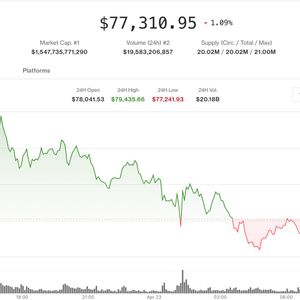
The United States military has confirmed it is actively operating a Bitcoin node and using the network for cybersecurity testing, marking a notable shift in how the government views blockchain technology beyond finance. Admiral Samuel Paparo, commander of the U.S. Indo-Pacific Command (INDOPACOM), disclosed the development during a recent Senate Armed Services Committee hearing, stating that the military is running a live node on the Bitcoin network and conducting “operational tests” to strengthen network defense capabilities. The full hearing was streamed live on YouTube , where Paparo said, “We’re not mining Bitcoin. We’re using it to monitor, and we’re doing a number of operational tests to secure and protect networks using the Bitcoin protocol.” According to Paparo, the initiative focuses on BTC as a tool in computer science and security, rather than as a monetary asset. The tests explore how the network’s underlying architecture, particularly its cryptography, blockchain architecture, and proof-of-work mechanism, can be applied to protect sensitive systems. Paparo told lawmakers that this feature can be used to increase the cost for adversaries conducting cyberattacks, potentially strengthening deterrence in digital warfare. What does the military actually use a Bitcoin node for? The military is using a Bitcoin node to run cybersecurity tests and get direct access to the BTC network without using a third-party service. According to Paparo, Bitcoin’s decentralized nature makes it a valuable security tool, and he explained the military’s interest to Congress. “Our research into Bitcoin is as a computer science tool. It’s the combination of cryptography, a blockchain, and proof-of-work. And Bitcoin shows incredible potential as a computer science tool that, through the proof-of-work protocols, actually imposes more cost than just the algorithmic securing of networks and our ability to operate.” Two years back, Paparo criticized crypto in front of a separate Senate hearing and said crypto assets are a gateway for proliferation, terror, and illicit trafficking. He said countries like North Korea and illegal arms dealers use crypto “outside of the eyes of the law.” However, he’s now in favor of BTC and says, “anything that supports all instruments of national power for the United States of America is to the good.” Paparo even confirmed that INDOPACOM’s research focuses on BTC’s computer science architecture rather than its price, after Sen. Tommy Tuberville (R-AL) asked whether U.S. leadership in Bitcoin puts the country ahead of China in the Indo-Pacific. According to data from BitcoinTreasuries.NET , China holds about 190,000 BTC ($14.88 billion) after seizing most of it during the 2019 PlusToken fraud bust . And even though Beijing never disclosed its full holdings, that balance gives China a strong position in the BTC ecosystem. Compared to China, the U.S. holds the biggest Bitcoin reserves worldwide and controls a large percentage of the global Bitcoin hashrate. Just last month, as reported by Cryptopolitan , Senators Bill Cassidy and Cynthia Lummis introduced the Mined in America Act to expand domestic production of BTC mining hardware. The bill also aims to make the Strategic Bitcoin Reserve established by President Donald Trump into law . BTC rises past $77,000 amid military testimony Paparo’s testimony sparked a surge in BTC activity, with prices rising past $77,000 on April 22 and the Bitcoin Fear & Greed Index hitting a three-month high. The BTC supply tightened even further as companies like Strategy by Michael Saylor bought 34,164 BTC for over $2.5 billion. Billionaire investor Anthony Scaramucci even said the coin’s market cap could reach $21 trillion. This means each Bitcoin could be worth about $1 million. Paparo also praised the GENIUS Act by President Trump and called it “a great step forward that moves us in that direction” of maintaining global dollar dominance. The U.S. Department of the Treasury’s Office of Cybersecurity and Critical Infrastructure Protection (OCCIP) also launched a new initiative to combat cyberattacks. Companies can now share threat details with the government for better countermeasures. External threats, such as North Korea’s involvement in cryptocurrency, are also among the reasons the U.S. military continues to test decentralized networks for security. The Lazarus Group made away with $600 million from various crypto exploits in April 2026 alone, which makes this new military initiative even more urgent. There’s a middle ground between leaving money in the bank and rolling the dice in crypto. Start with this free video on decentralized finance .